Showing posts with label Udyam. Show all posts

Thursday, November 10, 2011

Udyam 2011- Day 2- Keynote Address by Hon. Justice C Joseph


Day 2 @ Udyam 2011 began with the keynote address by Hon. Justice C Joseph, Supreme Court of India.
Excerpts from Hon. Justice Joseph’s address is shared below
“Distinguished panellists, members of the faculty, my dear students and other participants, a very sensitive and controversial subject you have chosen. Being a sitting judge of the supreme court I have my limitations to express my views on matters that would come for consideration in court. Bearing in mind of my limitations I would share my views today.
This is a leadership summit; I believe that those who are invited to share their views here are perceived to be leaders in the society. I have also noticed that those who are invited are not in politics. It is heartening to know that there are people who realize that leaders are not confined to the politics but also outside that realm. Leadership can’t be restricted to politics. Unfortunately in our country, leadership takes the hues of being part of politics
I am happy that you have taken a wider perception of leadership. In our society there are too many leaders, but there are very few good leaders.
It is possible to go to internet and view the readings of the great men who have defined leadership, but I always felt that what my teacher in primary school told me still holds good and I have not come across a better learning during these 65 years.

My teacher told me that a good leader is one who knows the way, shows the way and goes the way.

We have many leaders who do not know anything, still there are many people who know nothing but show the way and go the way. It is this conflict between precept and practice that baffles the society”

Hon. Justice Joseph went on to share a story from his hometown about an Anti-Liquor Rally that was organized by Gandhi Peace organization, which got disrupted because one person who is notorious for his alcoholism came in front of the anti-liquor rally and demolished the very credibility of the rally by his act. He drew parallels from this story with the society of today, as the people who jump on the bandwagon of corruption today also do not have the same level of credibility to lead such a rally against corruption.

Any number of laws, judges, policemen and punishment would not eradicate corruption, if that would have been possible it would have been eradicated. People are so ingenious that they find a way to get out of law as soon as a new law is created. What is required is a change of heart as far as every individual is concerned which can only be achieved if there is a commitment to justice.
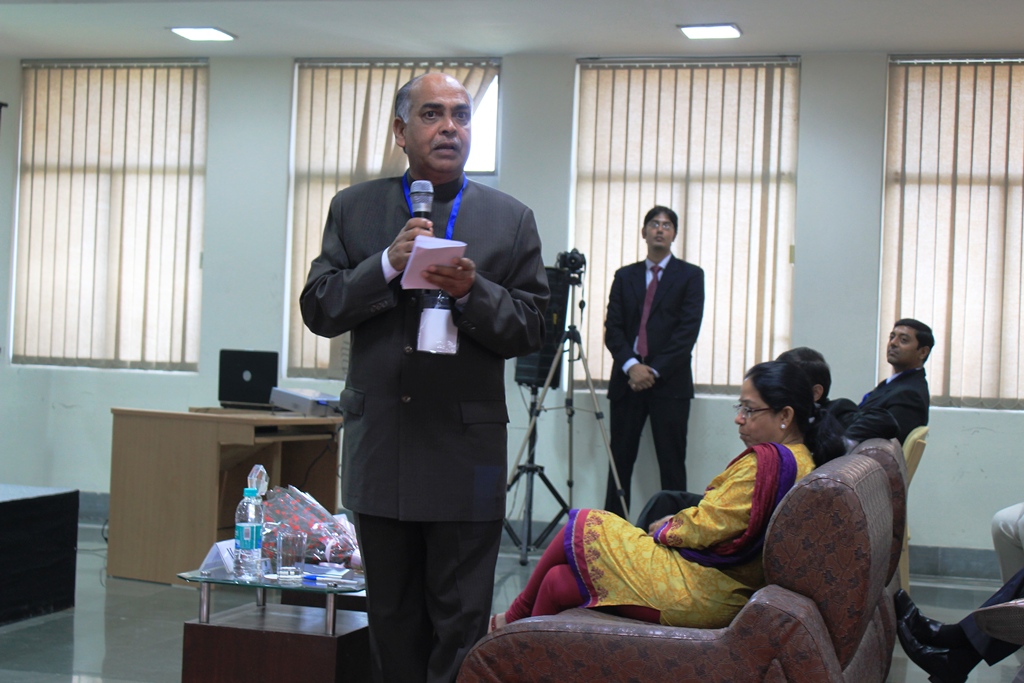
Justice Joseph eloquently described justice as follows
“Justice implies that everyone gets what he needs and none takes more than what he deserves. You deserve something as the outcome of what you have put in, no one should take more than what he deserves .In a just society it is not enough to live and let live, but we must try to live and help live others”

He further mentioned that justice demands concerns and compassion for others. If one helps to identify the just society in this way, it would help each one of us tackle the problem of corruption. Most often one indulges in corruption by choice, he has the other option of choosing opportunity and freedom to desist from being corrupt but for his own reasons he makes a choice to be corrupt.

From his experiences he had come to realize that even though corruption is all pervasive in India, we shall not ignore the positive aspects of our society and Justice Joseph urged the audience to think about the positives of our society as well, which often get overlooked and forgotten, and the negative side is exaggerated.
Justice Joseph said that there are many honest politicians, bureaucrats, social workers and businessmen who have been aiding in the development of India over the last 6 decades and we should not ignore or forget them in our anxiety to condemn what is wrong in the society.

Our focus should be to become prophets of hope rather than prophets of doom.

Finally Hon. Justice Joseph closed this extremely motivating and thought provoking keynote address by congratulating IIM Lucknow for organizing this discussion and hoped that it motivates us to play a more active role in eradicating corruption.

-By Saurabh
Event and Media Committee

Udyam 2011-Day1-Keynote Address by Mr. M.Damodaran


Udyam is a quest from IIM L to participate towards nation building and contribute in means and manner required by country at different stages of growth. So each year IIM Lucknow tries to bring to fore the issues that either paralyse our country or issues that are pertinent to the sustainable growth of our country.

The topics covered for this year's summit were

Innovation Led growth model for India
Corruption: By Choice or compulsion ?
Green Business: Enabling a sustainable future
Role of HR in imbibing CSR Culture in Organization


Day 1 of the annual leadership summit “Udyam 2011” started in the traditional way of lighting the lamp by Dean Archana Shukla and the chief guest for the day Mr M.Damodaran,former SEBI Chief.


Thereafter Mr M.Damodaran officially inaugurated the event by delivering the keynote address and illuminating the audience with his pearls of wisdom.

Mr. Damodaran started his address by mentioning that young women and men of India, should be at the centre stage of India’s growth and development effort. He said that he takes this opportunity to try and provoke the audience on where India is and where it can be if we all do the right things and where India would be if we don’t do those things.
He went on to talk briefly about each of the three areas which were part of the planned panel discussion in this leadership conclave.

On corruption he mentioned that we look at corruption as a standalone phenomenon that needs to be addressed, and focus more on symptoms rather than the disease. He mentioned that corruption is something that held his generation back as the older generation did not have access to information.He exhorted the virtues of the younger generation of constantly asking questions and appreciated this urge of the younger generation to understand what is unknown. Rather than being a nation of “Yes mans” we now need to develop a critical and analytical temper which helps in nation building.

Mr. Damodaran urged the audience to realize that the society is maligned by "acceptable corruption" and even enlightened, intelligent and articulate people don't question this.We should not be tricked by persuading oneself that there are only few problems which exist and we as a nation need to realize that there are a number of bumps along the way.

Mr.Damodaran further shared his views on Corporate Social Responsibility and how it has become a new trend in the Industry. However CSR should be expressed in terms of what it means, our outlook on CSR has not been clearly drawn out.
Events such as Udyam are held to ignite the minds of future leaders of India to think on how to shape the future of this country. He encouraged each member of the audience to believe in himself and tell oneself that no matter what your experience has been there is a leader each one of us.

He ended the keynote address stating that

"It is important that we allow the leader in each one of us to come out, fed on the right values and incentives and that is what conclaves of this kind foster".


-By Saurabh
Events and Media Committee

Friday, October 14, 2011

IIM Lucknow Presents -"Udyam"- The Leadership Summit !!!

IIM Lucknow Udyam 2011


Come November 4 and 5th 2011, IIM Lucknow's Noida Campus would play host to the annual leadership summit- "Udyam-2011"

“Udyam 2011” is IIM Lucknow's endeavour to provide a platform where eminent personalities from government, corporate world and society exchange thoughts on the topics that are going to shape the future of India Inc. Udyam is the leadership summit that addresses the most current issues that touch industry, politics and society.

The summit aims at providing a channel for confluence of ideas to surmount the challenges faced by industry, government and society.

Event Dates: 4-Nov-2011 to 5-Nov-2011
Venue: IIM Lucknow- Noida Campus

Please visit the main event website for details about the event and the program schedule:  http://www.iiml-udyam.com

Details of the Page are also available at : http://lifeatiimlipmx.wordpress.com/udyam-2011/

Wednesday, November 10, 2010

Sustainability – A Business Imperative

Sustainable development is the kind of development which satisfies the current needs without endangering the future generations to satisfy their own. Sustainable development is a complex and multidimensional issue, which combines efficiency, equity, and intergenerational equity based on economic, social, and environmental aspects. These three aspects are fundamental to the concept of sustainability and are closely linked. Businesses operate in these spheres simultaneously and hence most affected by the sustainability as a strategic and competitive force.

Sustainability is no more just an issue or a point of differentiation for the businesses. Sustainability has become megatrend which is sweeping the business world off the very foundations they were thriving on. It is no more about launching a campaign or a plan or a vision, it has to be much more deep rooted, much bigger force to reckon with. World over winds of change have already started blowing. Over the past 10 years environmental issues have steadily affected the way businesses are seen or supposed to function. Earlier the only function a business was supposed to carry out was to make profits for the owners. But now it is expected from businesses to create sustainable value for all the stakeholders in the value chain including society.

In this globalized era, workforces and worldwide suppliers are creating environmental pressures. The rise of emerging economies has fuelled the competition for scarce resources emphasising prudent use of available resources. Carbon emissions, water, energy are no more local issues of a nation; these have become global issues as actions of one country affect other nations too. Investors have started looking environmental issues central to firm’s performance and they seek information on sustainable initiatives a firm is taking up. Customers have started valuing those companies more which are genuinely concerned about environment and society. More over government concerns is ever growing over the issues of climate change, food security, energy security, industrial pollution, natural resources depletion among others. This is bound to change the regulatory environment of a business if not presently then in near future. More and more companies are now moulding their strategy and taking up investment in energy efficiency, pollution control, carbon footprint reduction, renewable power which is going to change the competitive landscape once and for all. Venture investing in clean technology reached a nearly $9 billion annually in 2008 and it is picking up again after slowdown in 2009. The private-sector investment into the clean technology marketplace has been estimated at more than $200 billion a year—with fast growth not just in the United States and Europe but in China, India, and the developing world. G20 governments have earmarked some $400 billion of their $2.6 trillion in stimulus funds for clean technology and sustainability programs.

Even if in short term businesses ignore sustainability but in long term it will not be just competitive advantage but a business imperative.

Visit us at www.iiml-udyam.com

Friday, October 15, 2010

Sustainability: Investing in a better future

“Nothing in excess” goes the maxim often heard and taught. But in practice, we have exploited Earth’s resources like there’s no tomorrow. As a result, we are facing the consequences of our excesses manifested in Global warming, water scarcity and ruined ecosystems. Our cities have grown inorganically with huge asymmetries in their development. Just to put a figure to that; 30% of India’s 1.1 billion population lives in urban areas. Of that more than 70% resides in just 10% of the cities. Not only have the resources depleted at alarming rates, they have been grossly polluted.

‘Sustainability’ is the need of the hour. Sustainability is defined as “Meeting the needs of the present without compromising the ability of future generations to meet their own needs.” It’s all about using living in a way that resources serve us in perpetuity. So what do we need to do to live in a sustainable manner? We must reduce our ‘Ecological Footprint’. Ecological footprint a measure of humanity’s demand on nature and measures amount of land and water a given population needs to produce the resources it consumes and to absorb the wastes, using prevailing technology. A lot of green standards abound that tell us how to design our buildings in an environment friendly way. But what we actually need is better planning of our cities.

I refer to an article on building new cities in the 21st century that compared two cities viz. Barcelona and Atlanta. Both are former Olympic hosts with populations of around 2.8 million and with roughly the same standard of living. Yet, the per capita ecological footprint of Atlanta is four times that of Barcelona! Indeed, Barcelona’s per capita environmental impact is lower than even that of many rural areas of Europe. In India the large cities are already bursting at the seams and every day newspapers are full of problems faced due to rampant in-migration. We cannot stop people from choosing where they want to live and work. The answer lies in creating sensible templates for urban planning.

So what should be our strategy for a sustainable future? We need to design compact cities and stop creating flat urban sprawls. Our Cities should have an optimized circulation plan alongwith an efficient Public transport built into the urban design. Studies suggest that reducing the sprawl and better public transport alone can bring in a 30% reduction in energy usage. Building sustainable cities would involve significant costs in modifications to existing city structures and building new cities. However, sustainable development must be treated as investment and not consumption. Only in this way will capital including our natural capital be available for future re-investment.

Neerad Swaroop